


|
|
|---|


.jpg)


Wednesday, May 18, 2011

Although Hyundai first pulled the wraps off the 2012 Accent at the Montreal auto show back in January, in Canadian-market form, it didn't pull the wraps off the U.S.-spec version until at the New York auto show—just a few months before the model's summer arrival at dealerships.
Four-door sedan and five-door hatchback variants of the Accent will be offered this time, and the new subcompact model adopts Hyundai's "Fluidic Sculpture" design philosophy, which blends flowing, graceful sheetmetal with some more pronounced, purposeful creases. Especially noteworthy are the distinctive, upward rear taillamps, which look like a fresher take on cues we've seen in the Elantra Touring. The hatchback design especially 'pops' from the back, where that beltline crease wraps all the way around the hatch and taillamps.

All Accents ride on a 101.2 inch wheelbase, 2.8-inches longer than the previous generation. The 66.9-inch width on all 2011 models increased by 0.2 inches for 2012. The Hyundai Accent 4-door's overall length has increased by 3.5 inches to 172 inches. Total length of the new five-door version is 162 inches. As a result, Accent enjoys superior interior volume and passenger space. While the car's exterior dimensions are consistent with those of traditional subcompacts, Hyundai Accent is classified by the EPA as a compact sedan thanks to its interior volume. Toyota Yaris and Ford Fiesta are classified as subcompact cars. In addition the Hyundai Accent five-door has best-in-class cargo volume and more cargo capacity than the Nissan Juke and Infiniti EX 35 crossover. The Accent has best-in-class front and rear shoulder room and the five-door also has more cargo volume than many of its compact five-door competitors.

The 2012 Hyundai Accent joins the Hyundai line-up sporting the company's increasingly popular "Fluidic Sculpture" design. The vehicle's exterior lines are intended to be futuristic, dynamic, and sleek. In a segment typically associated with staid designs, Accent stands out from the crowd. While the styling provides an attractive form, it's also functional, featuring a slippery 0.30 coefficient of drag for Hyundai Accent sedan and .31 for Accent five-door. Hyundai's signature hexagonal front grille and detailed swept-back headlights give Accent a compact athletic face. Five-door SE models include a sporty roof-mounted spoiler and vertical taillights. For an assertive stance, 16-inch alloy wheels are available on GLS and standard on SE.

The 2012 Hyundai Accent is the first vehicle to get the company's all-new 1.6-liter direct-injected (GDI) four-cylinder engine, making a claimed best-of-class 138 horsepower. It comes paired with either a six-speed manual or six-speed automatic transmission and accomplishes what we think will be another class best: EPA fuel economy figures estimated at 30 mpg city, 40 mpg highway for both manual and automatic versions, yielding a highway driving range of up to 456 miles.

SAFETY
Hyundai doesn't believe consumers should have to pay a premium for safety, so a long list of safety features is included as standard equipment on all 2012 Accent models. A total of six airbags protect occupants in the event of a collision, including two front impact airbags, two front seat-mounted side impact airbags, and curtain side-impact airbags for front and rear passengers. Hyundai Accent's new standard front-seat active head restraints help prevent whiplash by automatically reducing the space between a front occupant's head and the head restraint during certain rear collisions and are highly recommended by safety organizations such as the Insurance Institute for Highway Safety (IIHS). Active front head restraints are not available on Fiesta, Yaris, Aveo or Mazda2.
The Hyundai Accent's underlying structure is engineered to protect occupants using a Collision Load Dispersion mechanism and the rear doors have internal beams. The vehicle's structure distributes the force of an impact in three ways to minimize floor deformation and maintain the integrity of the cabin.
Electronic Stability Control (ESC) and Traction Control work together to help deliver confident handling in all conditions. Vehicle Stability Management (VSM) integrates control of the ESC and motor-driven power steering (MDPS) to provide handling assistance in slippery conditions or in sudden cornering scenarios. The system can deliver up to eight Newton-meters of counter-steering effort when required to assist the driver in maintaining control of the vehicle.
A key safety element for any vehicle is its braking system. Hyundai Accent is the only car in the subcompact segment to offer four wheel disc brakes as standard equipment. An Anti-lock Braking System (ABS) featuring Electronic Brake Force Distribution (EBD) and Brake Assist (BA) is also included. EBD examines the effect of vehicle load on weight distribution and apportions the braking force between front and rear axles to maximize stopping ability. In the event of a panic stop, BA ensures that maximum braking force is applied.
reference:www.thecarconnection.com,www.netcarshow.com

Although Hyundai first pulled the wraps off the 2012 Accent at the Montreal auto show back in January, in Canadian-market form, it didn't pull the wraps off the U.S.-spec version until at the New York auto show—just a few months before the model's summer arrival at dealerships.
Four-door sedan and five-door hatchback variants of the Accent will be offered this time, and the new subcompact model adopts Hyundai's "Fluidic Sculpture" design philosophy, which blends flowing, graceful sheetmetal with some more pronounced, purposeful creases. Especially noteworthy are the distinctive, upward rear taillamps, which look like a fresher take on cues we've seen in the Elantra Touring. The hatchback design especially 'pops' from the back, where that beltline crease wraps all the way around the hatch and taillamps.
All Accents ride on a 101.2 inch wheelbase, 2.8-inches longer than the previous generation. The 66.9-inch width on all 2011 models increased by 0.2 inches for 2012. The Hyundai Accent 4-door's overall length has increased by 3.5 inches to 172 inches. Total length of the new five-door version is 162 inches. As a result, Accent enjoys superior interior volume and passenger space. While the car's exterior dimensions are consistent with those of traditional subcompacts, Hyundai Accent is classified by the EPA as a compact sedan thanks to its interior volume. Toyota Yaris and Ford Fiesta are classified as subcompact cars. In addition the Hyundai Accent five-door has best-in-class cargo volume and more cargo capacity than the Nissan Juke and Infiniti EX 35 crossover. The Accent has best-in-class front and rear shoulder room and the five-door also has more cargo volume than many of its compact five-door competitors.
The 2012 Hyundai Accent joins the Hyundai line-up sporting the company's increasingly popular "Fluidic Sculpture" design. The vehicle's exterior lines are intended to be futuristic, dynamic, and sleek. In a segment typically associated with staid designs, Accent stands out from the crowd. While the styling provides an attractive form, it's also functional, featuring a slippery 0.30 coefficient of drag for Hyundai Accent sedan and .31 for Accent five-door. Hyundai's signature hexagonal front grille and detailed swept-back headlights give Accent a compact athletic face. Five-door SE models include a sporty roof-mounted spoiler and vertical taillights. For an assertive stance, 16-inch alloy wheels are available on GLS and standard on SE.
The 2012 Hyundai Accent is the first vehicle to get the company's all-new 1.6-liter direct-injected (GDI) four-cylinder engine, making a claimed best-of-class 138 horsepower. It comes paired with either a six-speed manual or six-speed automatic transmission and accomplishes what we think will be another class best: EPA fuel economy figures estimated at 30 mpg city, 40 mpg highway for both manual and automatic versions, yielding a highway driving range of up to 456 miles.
SAFETY
Hyundai doesn't believe consumers should have to pay a premium for safety, so a long list of safety features is included as standard equipment on all 2012 Accent models. A total of six airbags protect occupants in the event of a collision, including two front impact airbags, two front seat-mounted side impact airbags, and curtain side-impact airbags for front and rear passengers. Hyundai Accent's new standard front-seat active head restraints help prevent whiplash by automatically reducing the space between a front occupant's head and the head restraint during certain rear collisions and are highly recommended by safety organizations such as the Insurance Institute for Highway Safety (IIHS). Active front head restraints are not available on Fiesta, Yaris, Aveo or Mazda2.
The Hyundai Accent's underlying structure is engineered to protect occupants using a Collision Load Dispersion mechanism and the rear doors have internal beams. The vehicle's structure distributes the force of an impact in three ways to minimize floor deformation and maintain the integrity of the cabin.
Electronic Stability Control (ESC) and Traction Control work together to help deliver confident handling in all conditions. Vehicle Stability Management (VSM) integrates control of the ESC and motor-driven power steering (MDPS) to provide handling assistance in slippery conditions or in sudden cornering scenarios. The system can deliver up to eight Newton-meters of counter-steering effort when required to assist the driver in maintaining control of the vehicle.
A key safety element for any vehicle is its braking system. Hyundai Accent is the only car in the subcompact segment to offer four wheel disc brakes as standard equipment. An Anti-lock Braking System (ABS) featuring Electronic Brake Force Distribution (EBD) and Brake Assist (BA) is also included. EBD examines the effect of vehicle load on weight distribution and apportions the braking force between front and rear axles to maximize stopping ability. In the event of a panic stop, BA ensures that maximum braking force is applied.
reference:www.thecarconnection.com,www.netcarshow.com
Sunday, May 15, 2011

2011 Hyundai Sonata looks sleek, and thanks to a 270HP powerplant, drives with more muscle than you would expect.
For just under $20,000, the base 2011 Hyundai Sonata is a smart buy. The sleek styling, with a slight curve on the side and a low-angled front, recall a BMW 5-Series. A few choice tech features, including a dedicated 30-pin cable for your iPod Touch or iPhone, help keep you connected. And, fuel economy is outstanding at 24MPG in the city and 35MPG for highway driving. Yet, for those who want more muscle, the new Sonata Limited Turbo 2.0L, priced at $27,245, almost matches the BMW for speed as well, and only shaves 2MPG off fuel economy.
Now, to clarify: Hyundai is not in the same class as a BMW. The South Korean car company has set its sights on Honda and Toyota for some time. Some would argue that Japan fell asleep at the wheel and Hyundai is encroaching on their space. Still, you should not expect any luxury features such as a high-performance surround-sound stereo system or adaptive cruise control. Both the Sonata and the 2011 Kia Optima do have a BMW look and feel, though, especially compared to the 5-Series.

The 2011 Hyundai Sonata is a midsize family sedan available in GLS, SE and Limited trim levels. Standard equipment on the GLS includes 16-inch steel wheels, keyless entry, air-conditioning, cruise control, full power accessories, heated sideview mirrors, a tilt-and-telescoping steering column, a trip computer, a 60/40-split rear seatback, a six-speaker stereo (with CD/MP3 player, satellite radio, iPod/auxiliary audio jacks and steering-wheel-mounted controls) and Bluetooth with phonebook download.
Two optional equipment packages are available. One adds alloy wheels, automatic headlights and an eight-way power driver seat. The other includes all these plus a navigation system and upgraded speakers for the audio system. The sporty SE features all the above (except the navigation system and premium speakers) and adds 18-inch alloy wheels with performance tires, foglights, a dark chrome grille, a sport-tuned suspension, keyless ignition/entry, leather/cloth upholstery and a leather-wrapped steering wheel and shift knob. Opting for the turbocharged engine will also add dual-zone automatic climate control. An optional package bundles a navigation system with premium speakers and a sunroof.
The plush Limited has all the SE's features (minus the 18-inch wheels, sport suspension and cloth/leather upholstery) and adds side mirror turn signal repeaters, a sunroof, leather upholstery, heated seats (front and rear), dual-zone automatic climate control, an auto-dimming rearview mirror, an upgraded audio system (with HD radio and CD changer) and unique interior accents (either wood grain or gloss black). Seventeen-inch alloy wheels are also standard. The turbocharged SE variant adds 18-inch wheels, dual exhaust tips and steering-wheel-mounted paddle shifters. The Limited's sole optional package bundles a navigation system with a back-up camera and Infinity premium speakers.

Although it’s clear Hyundai has really upped its game with the 2011 Sonata, pricing has changed little from that of the previous generation. GLS models start at a competitive $19,915 with the six-speed manual; standard features include six airbags, ABS and electronic stability control, keyless entry, power windows and locks, heated and powered mirrors, and Bluetooth connectivity. An additional grand will net you the six-speed auto. Stepping up to one like our SE tester will run $23,315 to start and just over $26,000 with the optional Navigation and Sunroof package, which is the only major option. This combination suited us well, but sadly, it cannot be configured with heated leather seats. For that luxury, you must spend at least $26,015 for the Limited model, which also comes with dual-zone climate control, auto-dimming mirrors, vents for rear-seat passengers, and other unique, upscale bits. A $2100 Navigation package adds touch-screen nav, a rearview camera, and a premium Infinity audio system, bringing a loaded Sonata to just over $28,000.

The standard engine on all Hyundai Sonata trim levels is a 2.4-liter direct-injected four-cylinder engine good for 198 hp and 184 pound-feet of torque. The SE, with its dual exhaust, has a bit more power at 200 hp and 186 lb-ft. A six-speed manual transmission is standard on the GLS, while a six-speed automatic is optional on that trim and standard on the SE and Limited. A powerful 2.0-liter turbocharged engine is available on SE and Limited trim levels. This engine produces 274 hp and 269 lb-ft of torque.
In performance testing, a 2.4-liter GLS Sonata with the automatic transmission accelerated from zero to 60 mph in 8.2 seconds. As expected, the 2.0-liter turbo is significantly quicker, requiring only 6.7 seconds.
The Sonata's EPA fuel economy estimates are impressive for a car of this size. The 2.4-liter engine with the manual transmission is rated at 24 mpg city/35 mpg highway and 28 combined, and 22/35/26 mpg with the automatic. The 2.0-liter turbo, despite its significant boost in power, returns a very impressive 22/33/26 mpg.
The Sonata’s muscular 270-horsepower engine is frighteningly fast, and surprisingly so. We were not believers at first, questioning whether the “turbo” moniker (which forces air into the engine for increased pep) was more of a marketing concept. According to Hyundai, the Turbo accelerates from 0 to 60MPH in about 6.5 seconds – fast enough to cause the tires to squeal and push your head back.
Around corners, the Sonata Turbo provides a comfortable, assured ride. There’s no sense of the vehicle slipping, even going 70MPH on a bend meant for 45MPH, or pushing with too much force. Sure, the Audi A8 uses some advanced tech to relieve even more force on high-speed turns and makes them feel effortless, but the Sonata still does an admirable job of maintaining grip and suspension.
With the Turbo model, Hyundai added paddle shifters to give you a sense of control. They work well and are even easier to find. We had no trouble down-shifting to slow the car slightly around corners. Once again, we’re not talking about a Volvo or BMW transmission; you don’t feel any hesitation when you shift manually and you can willfully change gears anytime you want. But the Sonata does provide a better driving experience for those who want a little more control over the gears.

All Sonatas come well stocked with antilock brakes, traction control, stability control, front seat side-impact airbags, full-length side curtain airbags and active front head restraints.
In the government's new, more strenuous crash testing for 2011, the Sonata earned a top five-star rating for overall crash protection, with four out of five stars given for front-impact protection and five stars for side impact protection. In Insurance Institute for Highway Safety testing, the 2011 Hyundai Sonata earned a top rating of "Good" for frontal-offset, side-impact and roof-strength protection.
In Edmunds brake testing, a 2011 Sonata GLS came to a stop from 60 mph in 128 feet. A 2.0-liter turbo model with wider tires stopped slightly shorter at 120 feet. Both stopping distances are slightly better than average for cars in this class.
reference:www.edmunds.com,www.caranddriver.com,www.digitaltrends.com


The 2011 edition of the Hyundai Santa Fe isn't getting a full redesign, but a visual refresh does provide a few hints of the "fluidic sculpture" design language that debuted last month on the new Tucson and Sonata. The new hood features a pair of ridges extending back from the grille to the A-pillars as well as sculpted bars in the grille similar to the Sonata. The lower front fascia also gets some new forms that evoke a similar look to the Tucson.

The 2011 Hyundai Santa Fe is a five-passenger crossover SUV available in GLS, SE and Limited trim levels.
Standard equipment on the base GLS includes 17-inch alloy wheels, privacy glass, roof side rails, heated mirrors, keyless entry, cruise control, air-conditioning, rear seat air vents, a height-adjustable driver seat, a tilt-and-telescoping steering wheel, Bluetooth and a six-speaker sound system with a CD player, an auxiliary audio jack, an iPod/USB audio interface and satellite radio.
The Santa Fe SE gets 18-inch alloy wheels, automatic headlights, foglights, a windshield wiper de-icer, roof rack cross rails, an eight-way power driver seat with adjustable lumbar, leather/cloth upholstery, a leather-wrapped steering wheel and an auto-dimming rearview mirror. The Premium package adds a sunroof, a rearview camera, a touchscreen navigation system and an upgraded audio system.
The Santa Fe Limited adds a sunroof, dual-zone automatic climate control, heated front seats, full leather upholstery and a 10-speaker Infinity surround-sound audio system with a six-CD changer. The rearview camera and navigation system are also available for the Limited.

. Making its debut was the 2011 Hyundai Santa Fe. It is offered with a choice between two engines. First, there's a 2.4-liter inline-four that develops 175hp the same one offered on the Tucson and available as standard. There's also the 3.5-liter Lambda V6 releasing 276hp and 248 lb-ft of torque offered as an option. The fuel consumption of both engines has been improved, with the 2.4-liter unit achieving 20/28 mpg while the 3.5-liter unit posts 20/26 mpg. The new Santa Fe actually only features slight upgrades when compared to the 2010 version. Styling was modified slightly but the carmaker went for more significant engine upgrades. The 2.7-liter and the 3.3-liter V6 engines have been replaced by new units, which were specifically modified for improved fuel economy and lower emissions. Safety has also been improved. The Santa Fe now comes with six standard airbags, including side air curtain airbags, as well as ABS with BA, EBD, ESC, three-point seatbelts and adjustable head restraints and Tire Pressure Monitoring System.

On the road, the 2011 Hyundai Santa Fe offers predictable if not exciting handling, characterized by plenty of body roll and artificial feel to the steering. The ride quality is generally good, though models fitted with the larger 18-inch wheels tend to be a bit harsh on rough pavement. With either engine, the Santa Fe delivers good acceleration relative to other four-cylinder vehicles in its class, though the V6 is certainly the more impressive of the two, since it matches the lesser engine's fuel mileage as well.

Every 2011 Hyundai Santa Fe comes standard with four-wheel antilock disc brakes, brake assist, traction and stability control, front side airbags and side curtain airbags. A rearview camera is optional. In Edmunds brake testing, a Santa Fe Limited came to a stop from 60 mph in 126 feet -- a perfectly average distance.
The Santa Fe has not been rated using the government's new, more strenuous 2011 crash testing procedures. Its 2010 ratings (which aren't comparable to 2011 tests) were a perfect five stars in all frontal and side crash categories. The Insurance Institute for Highway Safety gave the Santa Fe its highest rating of "Good" in the frontal-offset and side crash categories.
Interior Design and Special Features
The Santa Fe doesn't enjoy the organic modernistic curves of the cabin in Hyundai's newer Tucson, but it nevertheless offers a relatively elegant environment compared to the Honda CR-V and Toyota RAV4. Quality of materials and their fitment are pretty much par for the course, with plenty of hard plastics thankfully broken up by soft touch points. The Santa Fe benefits from extremely simple controls, even with the available navigation system.
Some buyers may find it hard to get comfortable behind the wheel because of the overly high seating position and short bottom cushions that offer taller drivers minimal thigh support. The second row offers an above-average level of comfort, but doesn't slide like many of its competitors' seats do.
reference:www.autoblog.com,www.4wheelsnews.com,www.edmunds.com


Hyundai aims to break down the barriers of owning a luxury car with the introduction of its all-new flagship, the 2011 Hyundai Equus. Equus will compete with the best luxury sedans in the world on all levels including amenities, performance, advanced technologies, design and ownership experience when it arrives at select Hyundai dealerships in the late summer of 2010.
"Equus takes Hyundai's formula for intelligent luxury to a new level," said John Krafcik, president and CEO, Hyundai Motor America. "We've applied the lessons in engineering excellence we've learned with Genesis to the Hyundai Equus, while adding a new level of customer experience that will further differentiate our take on luxury from the traditional premium brands."
Hyundai Equus broadens Hyundai's lineup of premium vehicles and like Genesis, is built on Hyundai's world-class rear-wheel-drive architecture. It is powered by the award-winning 4.6-liter Tau® V8. The Tau inside the Hyundai Equus will produce an estimated 385 horsepower using premium fuel and 378 horsepower using regular fuel. With technology rivaling more expensive luxury sedans, Hyundai Equus showcases features such as a lane departure warning system, electronic air suspension, smart cruise control and a Lexicon® audio system.

If you're wondering whether a value-oriented brand like Hyundai can produce a luxury car, the cabin of the Equus will put your mind at ease. Just about every luxury and convenience feature found on a premium-badge car is available, and the quality of the design and materials is first class. It might not measure up to a European car like an Audi or Jaguar, but it matches anything you see from Acura, Infiniti or Lexus.
We particularly recommend the Equus Ultimate, a trim level that includes all the top-of-the-line features in a unique four-passenger configuration. The twin rear seats not only are both heated and cooled but also recline and offer a massage function. The passenger-side rear seat even has a power-operated footrest, though we've found in testing that it doesn't extend enough for passengers with long legs.
All navigation, climate, vehicle and entertainment information is displayed on a large LCD screen, while a knob and button array similar to the Audi MMI controls it. The climate controls consist of remarkably simple knobs and buttons. In a segment where vehicles can be hopelessly complex, the Equus does a good job of keeping its vast amount of technology manageable. Luggage space is a generous 16.7 cubic feet.
Driving Impressions
Silence. That's the most notable attribute of the 2011 Hyundai Equus. At idle it can seem as quiet as a hybrid vehicle with its engine automatically shut off. Once underway, things don't get much louder, as the engine is just a whisper, wind noise is virtually non-existent and only a slight tire howl can be heard because everything else is so hushed. Despite such a sedate driving environment, though, the Equus isn't a sleepy-handling limousine. There is some float to the ride in its normal suspension mode, but hit Sport and this big sedan becomes more buttoned-down over bumps. Through corners, it won't keep up with sport sedans like the BMW 7 Series or Jaguar XJ, but the Equus is stable and predictable enough if pushed.
While the power of the Equus measures up to the competition, you'll notice a little less thrust at low rpm while driving around town. This is most noticeable when accelerating from a stop, as the Equus doesn't provide the same immediate V8 punch as most other flagship luxury sedans.

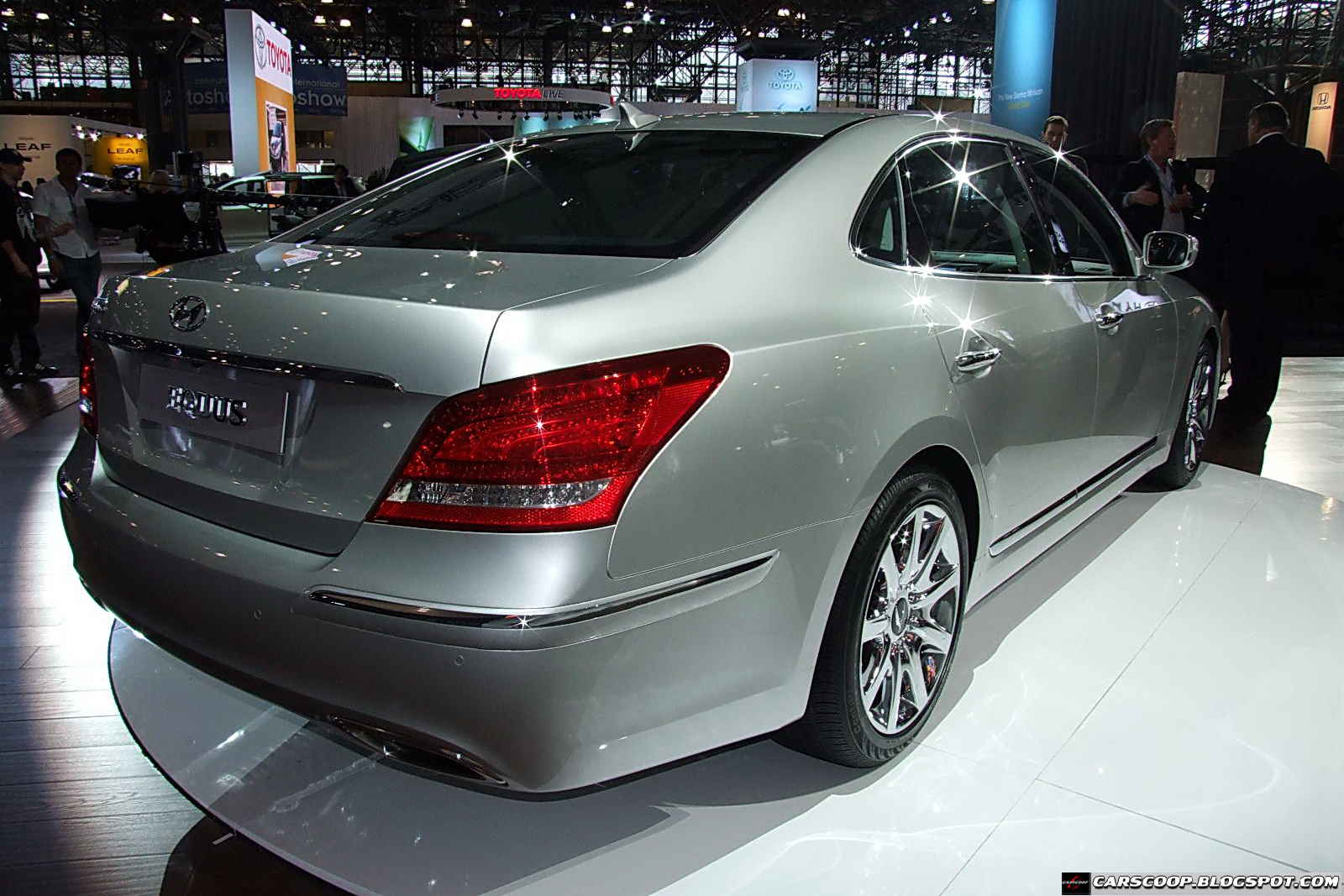
The design of the Hyundai Equus is handsome and pleasing to the eye. The rear-end treatment is progressive with bold taillights, strong shoulders and an overall look of precision. This look is accomplished through fully-integrated asymmetrical exhaust tips and rear LED turn signal indicators. The side silhouette is refined, with character lines that accent the rear fenders. Up front is a subtle horizontal radiator grille and well-proportioned headlamps with jeweled detailing. LED turn signals are inside the HID headlamps along with an adaptive front lighting system with white LED position lamps. The lower air intakes are bold and add to the positive reaction of the overall design. To assist in parking, and navigating blind corners and alleys in urban driving, there is an optional forward-view cornering camera integrated into the grille.
Driving dynamics are a critical element in every luxury sedan, and the Hyundai Equus offers first-rate ride and handling characteristics without traditional compromises. Hyundai Equus' electronically controlled air suspension meets the challenge of the wide variety of road surfaces drivers face everyday. For drivers who enjoy a firm ride and more stability when cornering there is a sport setting with additional body control. For customers who wish their ride to be a little on the softer side there is a normal setting for more ride compliance.
In urban areas, the Hyundai Equus is easy to maneuver and park, thanks to excellent steering and its electronic parking assist feature. While the Hyundai Equus is large, it doesn't feel over-sized or clumsy, that's due to its 37.7 foot turning circle and variable-effort steering system.
On winding country and mountain roads, Hyundai Equus benefits from the precise wheel control delivered by its five-link front and rear suspension geometry. This geometry is maximized through Continuous Damping Control (CDC) which continually monitors road and driving dynamics and adjusts damping force accordingly. The standard 19-inch chrome alloy wheel and tire package with staggered width (P245/45R19 front P275/40R19 rear) tires offers excellent gripping power and precise control.

Underneath its stately bodywork, the 2011 Hyundai Equus is based on the Genesis platform, but it's been enlarged to provide limousine-like interior room. The Equus comes standard with the 4.6-liter V8 that's optional equipment for the Genesis sedan, and it's good for 385 horsepower and 333 pound-feet of torque. Although this engine certainly delivers all the power you really need, it doesn't have the same low-rpm grunt as the V8s in other full-size luxury sedans. Rumor has it that Hyundai will replace the 4.6-liter V8 next year with a more potent 5.0-liter V8.

Maintaining Hyundai's emphasis on delivering leading safety technology, Hyundai Equus boasts world-class active and passive safety features to help prevent accidents, and maximize the well-being of its occupants in the event of a collision. The Hyundai Equus continues the Hyundai tradition of offering key safety technologies, with features such as Electronic Stability Control (ESC), nine airbags, electronic active head restraints, lane departure warning system and smart cruise control. Hyundai Equus even has a Vehicle Stability Management system (VSM) that optimally manages ESC, the electronic parking brake, smart cruise control and the seatbelt tensioning system for optimal safety.
Hyundai Equus' total of nine airbags include advanced dual front airbags, front and rear seat-mounted side-impact airbags, roof-mounted side curtain airbags for both front and rear outboard seat occupants and a driver's knee airbag.
Hyundai's lane departure warning system offers a warning light and chime after a one- second lane departure, and adds a haptic warning via the seatbelt after a three second lane departure.
Smart cruise control automatically manages the Hyundai Equus' speed through the braking and throttle systems to maintain a specified following distance selected by the driver.
The electronic parking brake with automatic vehicle hold enables the parking brake to hold the vehicle automatically when the vehicle stops, and deactivates as soon as the gas pedal is pressed.
Hyundai Equus has an optional camera located on the front grille and a standard camera on the rear decklid. These cameras help detect how close objects are when parking. Distance is indicated on the in-dash LCD monitor.
Hyundai Equus is brought to a halt by large four-wheel anti-lock disc brakes with Brake Assist and Electronic Brake Distribution (EBD). The 13.6-inch front rotors have four-piston fixed calipers and the rear brakes feature 12.4-inch rotors with single floating piston calipers.
reference:www.netcarshow.com,www.crunchgear.com,ww.edmunds.com

As we gaze out our office window at the 2011 Hyundai Elantra compact sedan, we are prepared to forgive Hyundai for ever uttering the phrase “Fluidic Sculpture,” the company’s intensely awkward tag line for its current styling.
This is because Hyundai’s fifth-generation Elantra is the one car in this reinvigorated class that actually looks like anything at all. That the Elantra’s jutting-jaw face has a passing resemblance to the Montauk Monster, the half-decayed and unidentified creature that washed up on a New York beach and into internet notoriety, is actually not at all a bad thing. We suggest, though, that Hyundai consider describing the Elantra’s styling as “Pelt-ic Sculpture,” since it appears that an extremely strong headwind has peeled back the dermis from its face and sent it flapping and undulating down the side of the body. And somehow, it looks great.

The interior materials are certainly on the upper end of the spectrum for this segment, with the majority of the controls placed on the tight, compact center stack. The iPod integration on the base GLS model can be little tedious, with users being forced to scroll through their ostensibly large list of artists and songs using the standard audio controls, but the LCD screen on the Limited makes the task less frustrating.
Once you get your music sorted out, you’ll find the Elantra is at home on the highway, where the car moves silently and effortlessly across the open road, immune to crosswinds or buzzy powertrain noises that plagued the previous generation of small cars.
he driving position immediate strikes us as better than many competitors, and the ride quality, while not as composed as the Cruze or Corolla, won’t trouble the average customer looking for a comfortable, compliant ride.
Rear seat passengers will find adequate space, despite the sloping roofline’s propensity to minimize headroom on other cars. Overall, we’re pleased with the Elantra’s styling, which looks like a more rotund version of the current Sonata, and will likely prove a hit with style-conscious consumers who can’t quite afford a premium nameplate.
Interestingly, the Elantra does share one trait with premium German luxury cars in that it looks best when equipped with large wheels and low profile tires.
One notable selling point not being touted by Hyundai is safety. One Hyundai rep stated that he wasn’t able to confirm if the Elantra would get a 5-star crash test rating, a near ubiquitous rating in the compact car category, let alone the mid-size class that the Elantra is technically classified as by the EPA.

The all-new Hyundai Elantra is fitted with a McPherson strut front suspension, with coil springs and gas shock absorbers. The rear suspension is a light weight coupled torsion beam rear suspension for enhanced steering stability and monotube shock absorbers for ride comfort. A 23.0 mm diameter front stabilizer bar helps reduce body roll when cornering.
All Elantras have column-mounted, motor-driven electric power steering that adjusts instantly to changing driving conditions while improving fuel economy over a conventional steering system. A quick-ratio steering rack is used for crisp feel on turn-in. Hyundai Elantra's turning diameter of 34.8 feet is better than Corolla's at 35.6 feet.
World-class weight efficiency was one of the program targets for the Hyundai Elantra engineering team. In fact, the 2011 Elantra leads all of its competitors in weight efficiency. Hyundai engineers also targeted leadership in power-to-weight ratio. Having these targets paid huge dividends in both performance and fuel economy.
The Hyundai Elantra's widespread use of high-strength steel provides a 37 percent increase in body stiffness at a lower body weight. High-strength steel allows the suspension to work optimally. At 2,701 pounds, the automatic transmission Hyundai Elantra GLS is lighter than its competitors, while offering more interior room than Focus, Cruze, Civic and Corolla, with body-bending rigidity 50 percent higher than the Corolla. This weight efficient unibody architecture allows for Hyundai Elantra to achieve an estimated 40 mpg EPA highway rating, without the need for a special eco model.

Under the hood, the Hyundai Elantra is powered by an all-new 1.8-liter Nu four-cylinder engine with 148 horsepower and 131 lb-ft of torque (145 horsepower and 130 lb-ft of torque for Elantra PZEV). The Nu engine was developed to replace the 2.0-liter Beta engine from the previous generation Hyundai Elantra. The Nu is smaller in size, weighs 74 pounds less and helps achieve an 18-percent improvement in highway fuel economy, when compared with its predecessor. Thanks to advanced clean engine technology, most Hyundai Elantras sold in California, Oregon and several Northeast states are certified as Partial Zero Emission Vehicles (PZEV) by the EPA. The PZEV Elantra is as clean as many hybrid electric vehicles. The PZEV Elantra helps Hyundai meet its environmental commitments. Outside of these "green" states, the Hyundai Elantra is available as an Ultra Low Emission Vehicle (ULEV).
The Nu engine features an aluminum block with a cast iron cylinder liner, cylinder head and crank. This unique configuration results in a block that is 30 percent lighter than an iron block, shedding more than 74 pounds off the entire engine weight, while still providing comparable strength.
The 1.8-liter Nu also offers Dual Continuously Variable Valve Timing (D-CVVT) camshafts and hydraulic engine mounts for optimum power, efficiency and refinement. Using D-CVVT on both camshafts has several advantages when compared with using it just on the intake camshaft. They include a two percent improvement in performance (increased volumetric efficiency), two percent improvement in fuel economy (reduced pumping loss) and a 30 percent reduction in hydrocarbon emissions. In the valvetrain, roller swing arms and hydraulic lash adjusters reduce valve driven friction to improve fuel economy one percent compared with direct valve driving. The Nu engine also features a maintenance-free silent timing chain system to enhance durability and improve Noise Vibration and Harshness (NVH).
The application of a plastic two-stage Variable Intake System (VIS), enables switching between long and short intake manifolds, resulting in an across-the-board performance increase. These result in a four percent improvement in performance, a 15 percent reduction in cost and 30 percent reduction in weight, when compared with aluminum.

Hyundai Elantra was one of the first compact sedans with ESC when it launched in July of 2007. The 2011 Elantra now takes compact car safety to the next level with the introduction of Vehicle Stability Management (VSM). Similar to the one found in the Hyundai Equus, VSM optimally manages ESC (Electronic Stability Control) and the Motor-Driven electric Power Steering (MDPS).
VSM works to control two effects. The first is when a driver accelerates or brakes on a split-mu surface (slippery on one side, dry pavement on the other) and the vehicle wants to pull in one direction. VSM detects this condition and sends a signal to the MDPS to apply steering assist. VSM counters the pull and automatically provides 8 Newton meters of counter steering. VSM reacts the same way during sudden lane changes or fast cornering. ESC is still not standard on the 2011 model year Civic.
Hyundai Elantra features six airbags - including dual front, front seat-mounted side-impact, and front and rear side curtain airbag.
The Hyundai Elantra also features a state-of-the-art braking package. The package includes four-wheel disc brakes (Civic, Jetta and Corolla still feature rear drum brakes) and an Anti-Lock Braking System (ABS) including Brake Assist, which provides maximum braking force when a panic stop is detected, and Electronic Brake-force Distribution (EBD), to automatically adjust the braking force to front and rear axles based on vehicle loading conditions. This package delivers shorter braking distances from 60 miles per hour than Civic, Corolla and Mazda 3.
Hyundai Elantra engineers even looked at something as simple as the parking brake, having introduced Hyundai's first integrated rear parking brake caliper for weight reduction.
In terms of passive safety, the Hyundai Elantra has strong unibody construction, along with front and rear crumple zones and the rear doors have internal dual beams unlike some of its competitors.
reference:www.autoguide.com,www.netcarshow.com,www.caranddriver.com


Bargain prices are great, but they tend to come with compromises. Shop at a 99 Cent store and you'll find amazing deals, but you'll also find limited sales assistance and harsh fluorescent lighting. This is why the 2011 Hyundai Azera is such a standout. With a starting price of just over 25 grand, it's a low-price leader in the full-size sedan segment, but no corners have been cut to achieve its very accessible price tag.
Feature content is one area in which the Azera exceeds expectations. Even base models come generously equipped with amenities such as steering-wheel-mounted audio controls and heated side mirrors. The range-topping Limited model adds luxury-car mainstays like heated leather seats and a sunroof without an exorbitant increase in price; an Azera Limited starts at just over 30 grand, making it less expensive than a base-model Toyota Avalon. The Azera also impresses with its fit and finish and its materials quality, which are superb throughout. However, we should note that the Azera was a bit squeak-prone in its first year of production, but we're unsure if Hyundai has tightened things up since then.

Inside, Hyundai Azera's spacious cabin provides not only roomy comfort, but a luxurious look with a new attention to detail that makes both driver and passengers feel like they are riding in a luxury sedan. These details include a new brushed metalgrain finish applied to the gear shift indicator area, cup holder cover, ashtray cover and center console cover and "EZ Lane Change Assist" (one-touch triple turn signal stalks). Slight movement of this new turn signal stalk will cause the turn signals to blink three times and then automatically go off - an ideal feature for highway passing.
The 2011 Hyundai Azera offers luxurious appointments and spaciousness that rivals the finest premium competitor brands. It offers a roomy cabin with nearly 44 inches of legroom up front and more than 38 inches of legroom for rear-seat passengers. Hyundai engineers have created efficient packaging to maximize interior volume with the 2011 Azera offering more interior volume (123.5 cu.-ft.) than the Toyota Avalon and Nissan Maxima.
Special attention has also been paid to other interior details, such as the electroluminescent cluster display and steering wheel audio control functions. The blue backlighting for interior gauges, switches and buttons along with ion-plated accents highlight the vehicle's modern appearance. Other unexpected luxury appointments include a power rear sunshade, integrated memory system and power-folding side mirrors with turn signal indicators and puddle lamps on the Limited version. Hyundai Azera Limited also has a power tilt and telescopic steering wheel, an integrated memory system, electrochromic auto-dimming mirror with HomeLink® premium door sill scuff plates and a woodgrain steering wheel and door pulls to its long list of standard equipment.
The Hyundai Azera comes standard with dual front automatic climate controls, solar control glass, power seats for driver and front passenger, as well as woodgrain and metalgrain interior accents.
An AM/FM/XM/CD/MP3 audio system that includes a four-channel, 172-watt internal amplifier and six speakers comes standard in the Hyundai Azera GLS. Audiophiles with even more demanding tastes will be impressed by the available Infinity audio system that includes a seven-channel, 315-watt amplifier with an in-dash six-disc CD changer and 10 speakers, standard in Limited trim levels.
Music lovers will also welcome the 2011 Azera's inclusion of standard iPod/USB and auxiliary input jacks to accommodate and charge audio devices such as iPods.
For drivers looking for the ultimate luxury options, Hyundai Azera offers the Limited Trim with Navigation Package which receives a powerful Infinity 605-watt Logic 7 audio system as standard equipment in addition to its LG DVD navigation system.

Hyundai Azera is reborn with a more handsome exterior design. The most noticeable exterior upgrade is a new sleeker front bumper fascia, with a number of subtle design tweaks. Design updates up-front also include redesigned headlamps with LED surround accent lighting, new chrome grille and round foglights. A high-gloss window trim treatment enhances Hyundai Azera's profile. The rear of the 2011 Azera features redesigned signature LED taillights, redesigned bumper with integrated chrome tailpipes and a matching decklid. Modernized 17-inch alloy wheels and revised side repeater mirrors with all-new bright puddle lamps light the way to Hyundai's refined premium large car with near-luxury attributes. Overall, Hyundai Azera's proportions remain elegant, purposeful and aerodynamically efficient, reducing wind noise while adding maximum stability on the highway.

The Azera GLS is equipped with a refreshed and improved 3.3-liter V6 engine that produces 260 horsepower and 233 pound-feet of torque. As the first member of Hyundai's 'Lambda' engine family, this engine has all-aluminum construction, dual overhead camshafts, four valves per cylinder and Continuously Variable Valve Timing (CVVT) for a broad power band. It also features a Variable Intake System (VIS) that further broadens its power curve to improve off-the-line acceleration and passing performance. Despite the increase in power, new EPA fuel economy estimates for the Azera GLS are improved to 20 mpg city / 28 mpg highway.
The Azera Limited delivers more performance due to its 3.8-liter DOHC V6 engine, which was also improved and delivers 283 horsepower and 263lb-ft of torque. To maximize the power band, this engine also utilizes CVVT and a VIS to help cylinders breathe efficiently at both low and high rpms. Like the 3.3-liter V6, the new EPA mileage figures for the Azera Limited with a 3.8-liter V6 have improved to 19 mpg city / 27 mpg highway.
Both V6 engines are matched with Hyundai's new six-speed automatic transmission with manual-style shift gate control. This new transmission is 26.4 lbs lighter than the five-speed it replaces, but also features 62 fewer parts and increased durability. Hyundai also added an "Eco Indicator" that displays a green light when current driving inputs reflect optimal fuel economy.

Maintaining Hyundai's emphasis on class-leading safety technology, the 2011 Azera boasts impressive active and passive safety features to protect its occupants in the event of a collision, earning the Insurance Institute for Highway Safety's (IIHS) top crash test ratings for frontal offset impacts. The Hyundai Azera continues to set standards by making key life-saving active safety technology standard, such as Electronic Stability Control (ESC) with a Traction Control System (TCS).
Also standard are independent double-wishbone front- and multi-link rear suspension, large four-wheel disc brakes and an Anti-lock Braking System (ABS) that includes Brake Assist, which provides maximum braking force when a panic stop is detected, and Electronic Brakeforce Distribution (EBD), which automatically adjusts the amount of force applied to each of a vehicle's brakes for optimal performance under poor road conditions, speeding, loading and other potentially hazardous situations.
Additionally, Hyundai Azera offers impressive passive safety features including eight standard airbags, active front head restraints to help prevent whiplash, a Lower Anchors and Tethers for Children (LATCH) system for children's seats and three-point seatbelts for all positions while shingle-style rear-seat head restraints provide drivers with improved visibility. Security is further advanced with an anti-theft engine immobilizer and remote keyless entry with alarm.
reference:www.edmunds.com,www.leftlanenews.com,www.netcarshow.com

Friday, May 13, 2011

For one, the 2012 Hyundai Accent looks pretty good for a car that competes in the “bargain” segment. During the presentation at the media event in Ibn Battuta Gate hotel, they mentioned things like “eagle eye” headlights and “character lines” that wrap right around the car. They seemingly put a lot of thought into making it look good, although there is only so much they could do with a small sedan.

Choosing a subcompact sedan no longer means foregoing comfort and convenience features. A standard 6-way adjustable driver’s seat and standard tilt steering wheel work in conjunction to provide a comfortable driving position. Power door locks, standard on all Accent models, can be paired with the convenience of available power windows, remote keyless entry, and power heated mirrors. A 4-speaker AM/FM/CD audio system with iPod / USB / AUX ports is standard equipment. Those seeking added listening enjoyment can opt for a 6-speaker, 172 watt AM/FM/XM/CD audio system featuring Bluetooth® hands-free phone connectivity and steering wheel audio controls. Cruise control, air conditioning, a leather-wrapped steering wheel, heated front seats, and a power sunroof are all available.

The car drives well in any road situation. The ride was surprisingly smoother than we expected, as the suspension seems a bit softer than most European sub-compacts, while wind and road noise at highway speeds was above-average, but within class standards. It can lose its composure a bit in crosswinds on the open road though, and constant steering corrections were required, as it is with most small cars. Forward visibility was good, the engine was adequate, the tiptronic gearbox chose gears perfectly by itself, the four-wheel-disc brakes worked fine, and the controls offered pretty solid feedback without being heavy, so it was rather enjoyable to throw around. Handling isn’t class-leading in the pursuit of comfort, but it is good enough to be somewhat entertaining, and on that long drive, we appreciated the balance. Our car had 175-width tyres on 14-inch wheels, so we expect the higher-spec model to behave a little more firmly with its 195-width tyres on 16-inchers.We racked up maybe more than 350 km to and from Fujairah using some back roads, and managed a fuel consumption of around 7.5 litres/100 km, but I was being very aggressive with the throttle and always had the seemingly-good a/c on in February afternoon weather, so it could likely do better.
The 2012 Accent joins the Hyundai line-up sporting the company’s increasingly popular Fluidic Sculpture design. The vehicle’s exterior lines are intended to be futuristic, dynamic, and sleek. In a segment typically associated with staid designs, Accent stands out from the crowd. While the styling provides an attractive form, it’s also functional, featuring a slippery 0.30 coefficient of drag. Five-door models include a sporty trunk lid-mounted spoiler. For an assertive stance, 16” alloy wheels are available.

The 2012 Accent can be had in GCC-spec with a 106 hp 1.4-litre or a 122 hp 1.6-litre engine, both mated to either a 5-speed manual or a 4-speed automatic. Unfortunately, Hyundai does not plan to import their Korean-market models which have the new direct-injection 138 hp 1.6-litre engine with the 6-speed automatic to keep prices low.
After the presentation, we headed out in convoy from the hotel in Dubai to Fujairah, with the promise of a free lunch at the Hilton there, with Hyundai execs hoping journalists actually test the car on the way. I was assigned to a blue one, which seemed to be the 1.6-litre base model, judging by its 14-inch steel wheels with hubcaps, lack of steering-wheel buttons, no centre-console storage cubby and no leather on the steering wheel. I only figured that out after seeing those items on a higher-spec model riding on 16-inch alloys.

Hyundai doesn’t believe that consumers should have to pay a premium for safety, so a long list of safety features are included as standard equipment on all 2012 Accent models. A total of six airbags protect occupants in the event of a collision, including two front impact airbags, two front seat-mounted side impact airbags, and curtain side-impact airbags for front and rear passengers. Active front head restraints and seatbelt pretensioners work in conjunction with the airbag system to aid in preventing injury.
The Accent’s underlying structure is engineered to protect occupants using a Collision Load Dispersion mechanism. The vehicle’s structure distributes the force of an impact in three ways to minimize floor deformation and maintain the integrity of the cabin.
Electronic Stability Control (ESC) and Traction Control work together to help deliver confident handling in all conditions. Vehicle Stability Management (VSM) integrates control of the ESC and motor-driven power steering (MDPS) to provide handling assistance in slippery conditions or in sudden cornering scenarios. The system can deliver up to 8 Newton-meters of counter-steering effort when required to assist the driver in maintaining control of the vehicle.
A key safety element for any vehicle is its braking system. Accent is the only car in the subcompact segment to offer four wheel disc brakes as standard. An Anti-lock Braking System (ABS) featuring Electronic Brake Force Distribution (EBD) and Brake Assist (BA) is also included. EBD examines the effect of vehicle load on weight distribution and apportions the braking force between front and rear axles so as to maximize stopping ability. In the event of a panic stop, BA ensures that maximum braking force is applied.
reference:www.motorauthority.com,www.drivearabia.com,www.autoguide.com

Monday, April 11, 2011

Specifications prices Modifications and Image Hyundai i40 2011
SELL - BUY CARS NEW AND USED
Russelheim - Hyundai Motors has just completed the ultimate test of the latest generation of New Hyundai i40 both sedan and estate versions. In fact, a number of photos the car has been leaked on various channels cyberspace. Understandably, this car immediately started their work in the global market in March coincided with a celebration of the upcoming Geneva Auto Show 2011.
Party Wagon Hyundai said the i40 was born from its subsidiary in Rüsselsheim, Germany, for the European market and also compete with rival VW Passat and Toyota Avensis. "Introduction to the Australian market i40 done later this year. The technology was never used on Hyundai models and models from other brands in its class,"said Roland Rivero, Senior Manager of Product Planning Hyundai.

Then a car designed and developed by Hyundai's R & D center in Germany, this has influenced exterior design Genus concept cars ever introduced in 2006.
To spur the kitchen sector, the car will use gasoline engine with a capacity of 2,000 cc four-cylinder with direct injection technology, which can generate power of 170 hp. They will also be provided with one single unit with a capacity of 2400 cc petrol engine GDI that can issue a power to 200 hp. However, these machines will only be available at the range top-of-the-Hyundai i40.
South Korean manufacturer will also be provided by two diesel engines with a capacity of 1700 cc engine capable of physical exertion to 115 and 136 hp. According to the plan, starting i40 will go on sale across Europe from late 2011. While the i40 will also be considered a hybrid version borrowed from the Hyundai Sonata.


